The $397 Lattice1: An Estimated $80 to Manufacture
A premium-priced hardware wallet. Commodity electronics. And serious questions about manufacturer trust.
GridPlus markets the Lattice1 as a premium cryptocurrency hardware wallet, with an approximately $400 retail price.
But how much does the physical device actually cost to manufacture?
Using publicly available hardware photographs, component pricing, PCB manufacturing rates, and volume-production assumptions, we reconstructed an estimated bill of materials and manufacturing cost for the Lattice1.
Our estimate: approximately $79.50 per device.
That means a product sold for $397 could have an approximately $317 retail-to-manufacturing cost spread before research, software development, quality assurance, logistics, support, and other operating expenses.
Maintainer-supplied model, not independently verified manufacturer costs or net profit.
The Numbers
| Metric | Estimated value |
|---|---|
| Retail price reference | $397.00 |
| Estimated manufacturing cost | $79.52 |
| Retail-to-manufacturing spread | $317.48 |
| Implied manufacturing gross margin | 79.97% |
| Retail price / estimated production cost | ~5× |
These are modeled economics, not GridPlus's reported manufacturing costs, accounting margins, or net profits.
What's Actually Inside the Lattice1?
Our analysis examined the device's processing hardware, security chips, memory, display, networking components, circuit boards, enclosure, assembly, and packaging.
Much of this hardware consists of commercially available embedded electronics.
Estimated Component and Manufacturing Costs
| Category | Estimated cost |
|---|---|
| Processing, security chips, memory and SafeCard | $27.66 |
| Display, networking and interface electronics | $25.65 |
| Power and supporting electronics | $5.36 |
| Circuit boards, enclosure and mechanical components | $11.29 |
| Assembly, packaging and factory overhead | $9.55 |
| Total | ~$79.50 |
The underlying estimates include identifiable or comparable components such as:
| Component | Estimated unit cost |
|---|---|
| Onion Omega2S+ Linux/Wi-Fi module | $6.00 |
| NXP K81 secure microcontroller | $9.32 |
| Comparable NXP secure element | $2.48 |
| 5-inch LCD touchscreen | $12.85 |
| RA8875 display controller | $8.00 |
| 64GB storage | $5.00 |
| One programmable SafeCard | $1.00 |
| Three custom bare PCBs | $5.00 |
| Two-piece plastic enclosure | $4.00 |
Some prices are supported by published distributor tiers; others represent compatible substitutes or modeled procurement prices. They are not confirmed prices paid by GridPlus.
What Would 5,000 Devices Look Like?
Our cost model assumes a hypothetical production run of 5,000 devices, existing tooling, volume purchasing, and one SafeCard per unit.
| Metric | Modeled total |
|---|---|
| Retail revenue at $397 each | $1,985,000 |
| Manufacturing cost | $397,600 |
| Retail-to-manufacturing spread | $1,587,400 |
This spread is not net profit. It excludes substantial costs associated with operating a hardware-wallet company.
Nevertheless, the modeled physical manufacturing expense represents approximately 20% of the retail price.
Does a $400 Price Tag Mean $400 Worth of Security?
No. Price alone proves nothing about a hardware wallet's security.
The physical cost of a secure microcontroller, tamper-detection circuitry, or cryptographic component does not necessarily reflect the engineering required to implement those components safely.
But customers paying a premium for a security device should understand the difference between hardware protections and manufacturer trust.
GridPlus controls the firmware-signing infrastructure used to authorize Lattice1 updates. In 2023, the company acknowledged that future firmware could hypothetically introduce private-key export functionality.
Its February 2024 firmware changelog subsequently documented a user-authorized, on-device seed-phrase recovery feature for compatible hardware.
That recovery feature does not establish malicious key extraction or remote exfiltration. It does demonstrate that firmware can change access to sensitive wallet information.
A cryptographic signature establishes that firmware was authorized. It does not independently guarantee that the signed code is safe.
A premium-priced wallet can still require substantial trust in the company controlling its software.
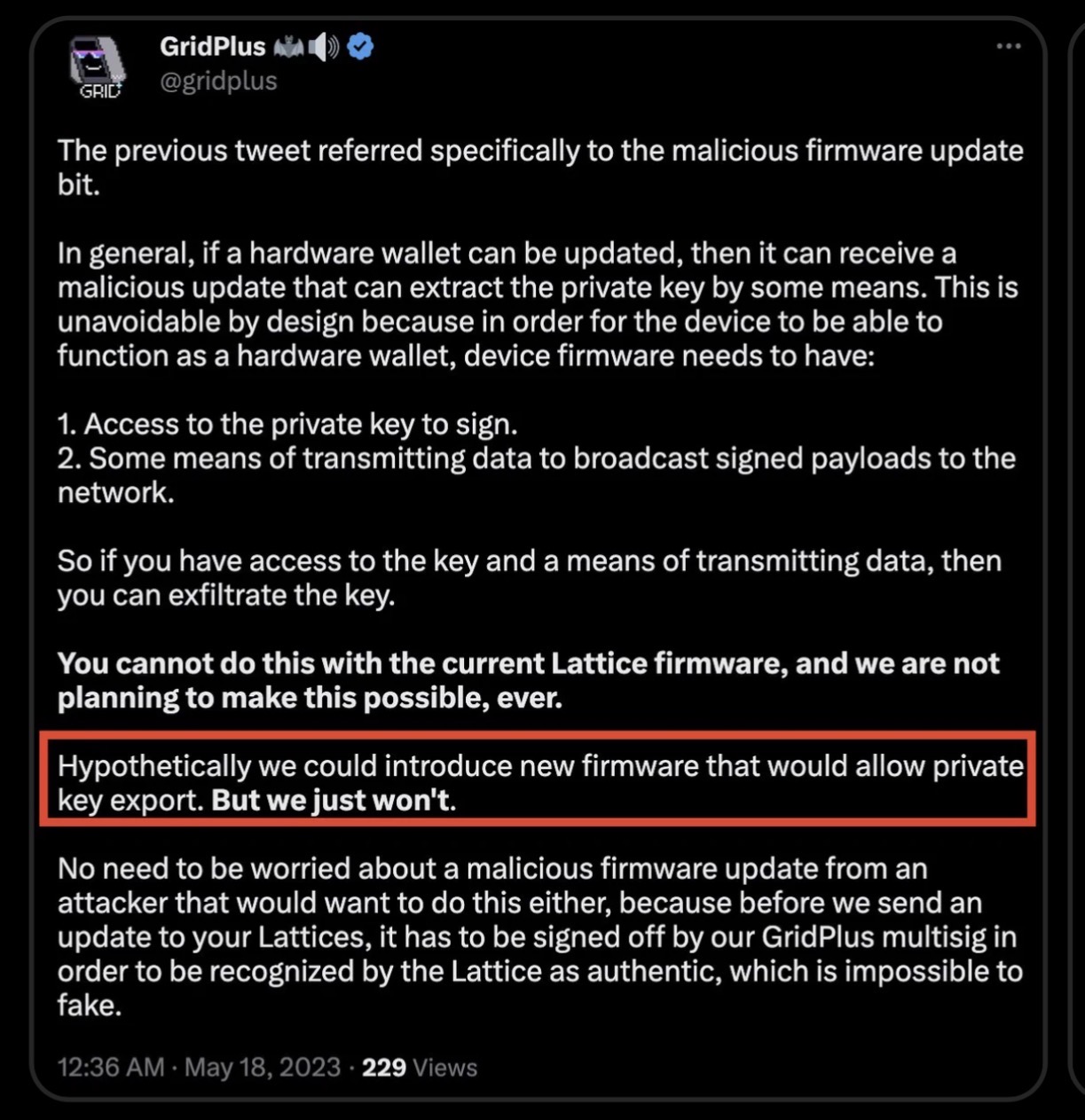
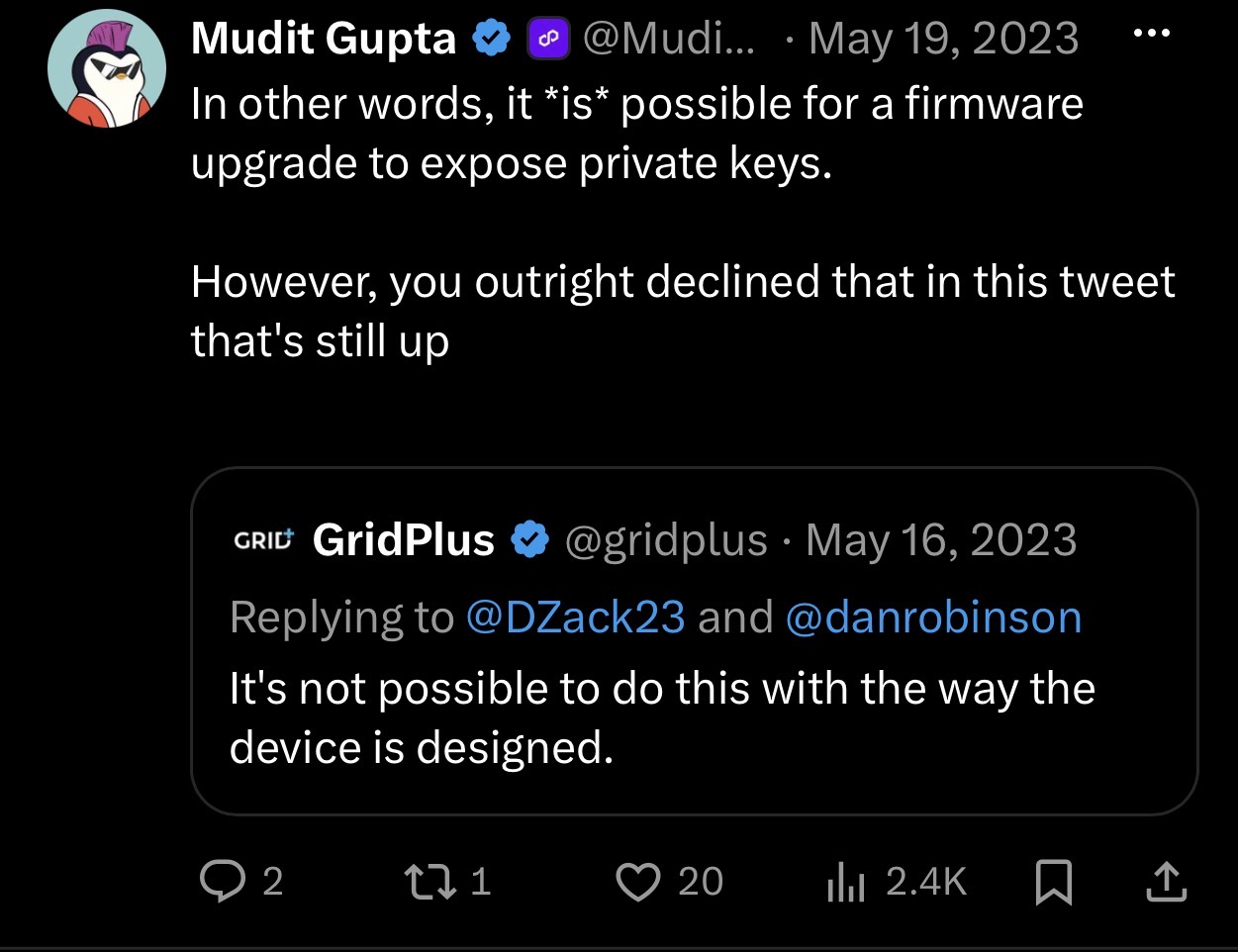
Captures of the public posts supplied by this website's maintainer; the posts were not independently retrieved from the platform. The dates shown are those displayed in the captures.
How We Estimated Manufacturing Cost
This analysis uses a bottom-up engineering model incorporating:
- Public FCC hardware photographs and identifiable component families.
- Published distributor prices and comparable electronic parts.
- Estimated fabrication costs for three custom circuit boards.
- Volume-production assumptions for enclosure manufacturing and assembly.
- Packaging and factory-overhead allowances.
The model assumes 5,000 devices, existing production tooling, and volume-oriented procurement.
It excludes functional testing, firmware provisioning, outbound shipping, payment processing, returns, warranty service, software engineering, security audits, customer support, marketing, and corporate overhead.
GridPlus has not provided a publicly verified complete production bill of materials or manufacturer quotation for this analysis. The estimated $79.50 cost should therefore not be represented as its actual factory cost.
Reference Sources
The Bottom Line
Our engineering model suggests that the physical Lattice1 hardware could be manufactured for approximately $80 per device in a hypothetical 5,000-unit run, compared with a reference retail price of approximately $400.
That difference may fund legitimate software engineering, security research, customer support, and operating expenses. The model alone cannot determine how much GridPlus actually spends on those activities.
But for a company selling a product whose principal purpose is protecting cryptocurrency assets, the more important question is not simply how much the hardware costs.
It's whether the security architecture, ongoing development, transparency, and trustworthiness of the manufacturer justify the premium.